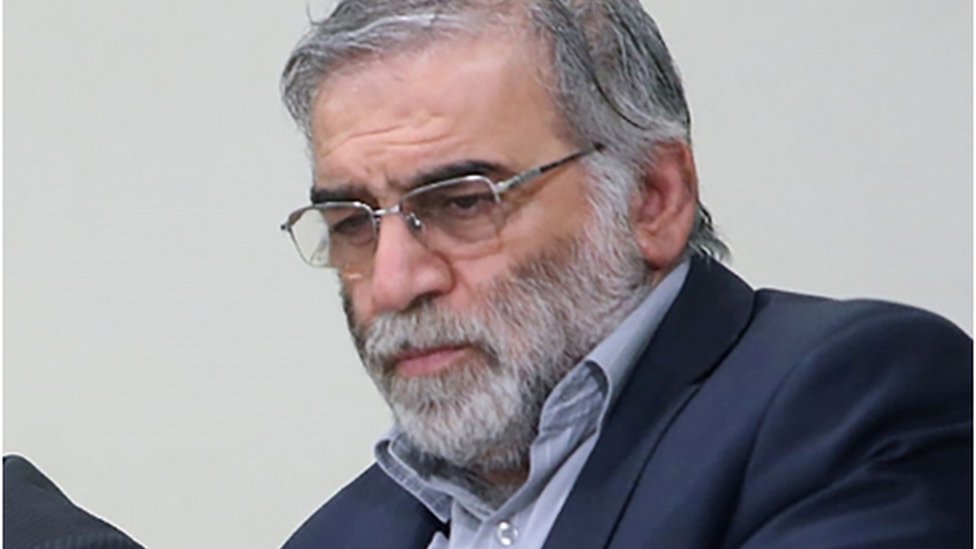
Iran's most senior nuclear scientist Mohsen Fakhrizadeh has been assassinated near the capital Tehran, the country's defence ministry has confirmed.
Fakhrizadeh died in hospital after an attack in Absard, in Damavand county.
Iran's Foreign Minister Mohammad Javad Zarif, has condemned the killing "as an act of state terror".
Western intelligence agencies believe Fakhrizadeh was behind a covert Iranian nuclear weapons programme.
"If Iran ever chose to weaponise (enrichment), Fakhrizadeh would be known as the father of the Iranian bomb," one Western diplomat told Reuters news agency in 2014.
Iran insists its nuclear programme is exclusively for peaceful purposes.
But news of the killing comes amid fresh concern about the increased amount of enriched uranium that the country is producing. Enriched uranium is a vital component for both civil nuclear power generation and military nuclear weapons.
A 2015 deal with six world powers had placed limits on its production, but since President Donald Trump abandoned the deal in 2018, Iran has been deliberately reneging on its agreements.
Joe Biden has pledged to reengage with Iran when he takes over the US presidency in January, despite longstanding opposition from Israel .
Between 2010 and 2012, four Iranian nuclear scientists were assassinated and Iran has accused Israel of complicity in the killings.
Fakhrizadeh's name was specifically mentioned in Israeli PM Benjamin Netanyahu's presentation about Iran's nuclear programme in May 2018.
There has been no comment from Israel on the news of the assassination. The Pentagon has also declined to comment, according to Reuters.
What happened to Mohsen Fakhrizadeh?
In a statement on Friday, Iran's defence ministry said: "Armed terrorists targeted a vehicle carrying Mohsen Fakhrizadeh, head of the ministry's research and innovation organisation.
"After a clash between the terrorists and his bodyguards, Mr Fakhrizadeh was severely injured and rushed to hospital.
"Unfortunately, the medical team's efforts to save him were unsuccessful and minutes ago he passed away."
Iranian media reports said the attackers opened fire on the scientist in his car.
Fars news agency earlier reported there was a car explosion in Absard town, with witnesses reporting that "three to four individuals, who are said to have been terrorists, were killed".
Why was he targeted?
As head of the ministry of defence's research and innovation organisation, Fakhrizadeh was clearly still a key player. Hence Benjamin Netanyahu's warning, two years ago, to "remember his name".
Since Iran started breaching its commitments under the terms of the 2015 Iran nuclear deal, the country has moved ahead rapidly, building stockpiles of low-enriched uranium and enriching to a purity above the level permitted under the deal.
Iranian officials have always said such moves are reversible, but developments in research and development are harder to eradicate.
"We cannot go backwards," Iran's former ambassador to the International Atomic Energy Agency (IAEA), Ali Asghar Soltanieh, said recently.
If Mohsen Fakhrizadeh was the key player Israel alleges, then his death could represent someone's effort to put the brakes on Iran's forward momentum.
With the US president-elect, Joe Biden, talking about taking Washington back into the deal with Iran, the assassination could also be aimed at complicating any future negotiations.
What has the reaction been?
"Terrorists murdered an eminent Iranian scientist today," Iran's foreign minister said in a tweet.
"This cowardice - with serious indications of Israeli role - shows desperate warmongering of perpetrators."
Mr Zarif called on the international community to "condemn this act of state terror".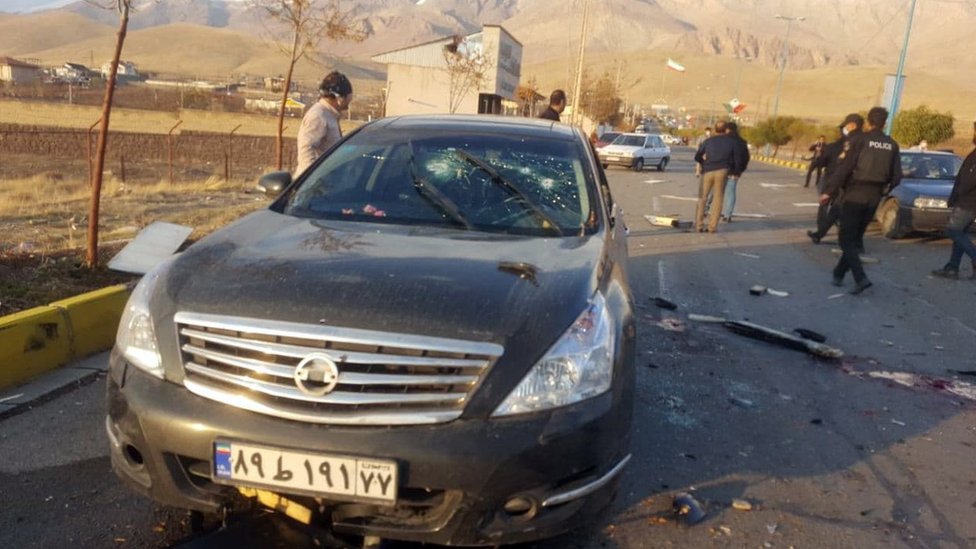
The commander of the Islamic Revolutionary Guard Corps (IRGC) has said that Iran will avenge the killing of the scientist.
Who was Mohsen Fakhrizadeh?
Fakhrizadeh is the most renowned Iranian nuclear scientist and a senior officer of the elite Islamic Revolutionary Guard Corps.
He has long been spoken about by Western security sources as extremely powerful and instrumental in Iran's nuclear programme.
According to secret documents obtained by Israel in 2018, he led a programme to create nuclear weapons.
In 2015, the New York Times compared him to J. Robert Oppenheimer, the physicist who directed the Manhattan Project that during World War Two produced the first atomic weapons.
A professor of physics, Fakhrizadeh is said to have led Project Amad, the alleged covert programme that was established in 1989 to research the potential for building a nuclear bomb. It was shut down in 2003, according to the IAEA.
The IAEA has long wanted to speak to him as part of its investigations into Iran's nuclear programme.
Suspicions that Iran was using the programme as a cover to develop a nuclear bomb prompted the EU, US and UN to impose crippling sanctions in 2010.
The 2015 deal that Iran reached with the US, UK, France, China, Russia and Germany saw it limit its nuclear activities in return for sanctions relief.
Since President Trump abandoned the deal, it has floundered. Earlier this month, the IAEA said Iran had more than 12 times the amount of enriched uranium than permitted under the deal.
Meanwhile, tensions between the US and Iran have escalated, peaking in January with America's assassination of Gen Qasem Soleimani, commander of the Iranian Revolutionary Guards' Quds force.


